Advisory and governance
Get senior cybersecurity leadership without hiring a full-time CISO
Spirity gives your organization a dedicated security advisor to assess risk, build a cybersecurity roadmap, support compliance, and guide security decisions at management level.
You may need a vCISO if…
Most organizations arrive here from one of six directions. Any one of them is reason enough to talk.
No internal security leader
You need senior cybersecurity guidance, but hiring a full-time CISO is not realistic yet.
An audit date, and no owner
NIS2, DORA, ISO 27001 or a customer audit is scheduled, and nobody inside the organization owns the answer.
Leadership needs clarity
Management needs simple, business-level reporting on cyber risks, gaps, and progress.
Customer or partner security requests
You need to answer questionnaires, supplier assessments, or security requirements with confidence.
Reactive cybersecurity
Security is mostly handled after problems appear, instead of through a clear plan.
No clear roadmap
You know cybersecurity needs improvement, but you are not sure what to fix first.
Introducing Virtual CISO Services
Powered by the Cynomi AI-driven platform and decades of hands-on CISO experience, our Virtual CISO service offers the benefits of an in-house CISO at a fraction of the cost.
Virtual CISO Services provide organizations with expert-level cybersecurity leadership by combining AI-powered tooling with industry best practice — tailored security strategies, risk assessments, and ongoing compliance support.
- One dashboard for security posture, compliance status, and open tasks
- A supplier risk heat map covering critical subcontractors and ICT providers
- Policies and registers generated against the framework you are held to
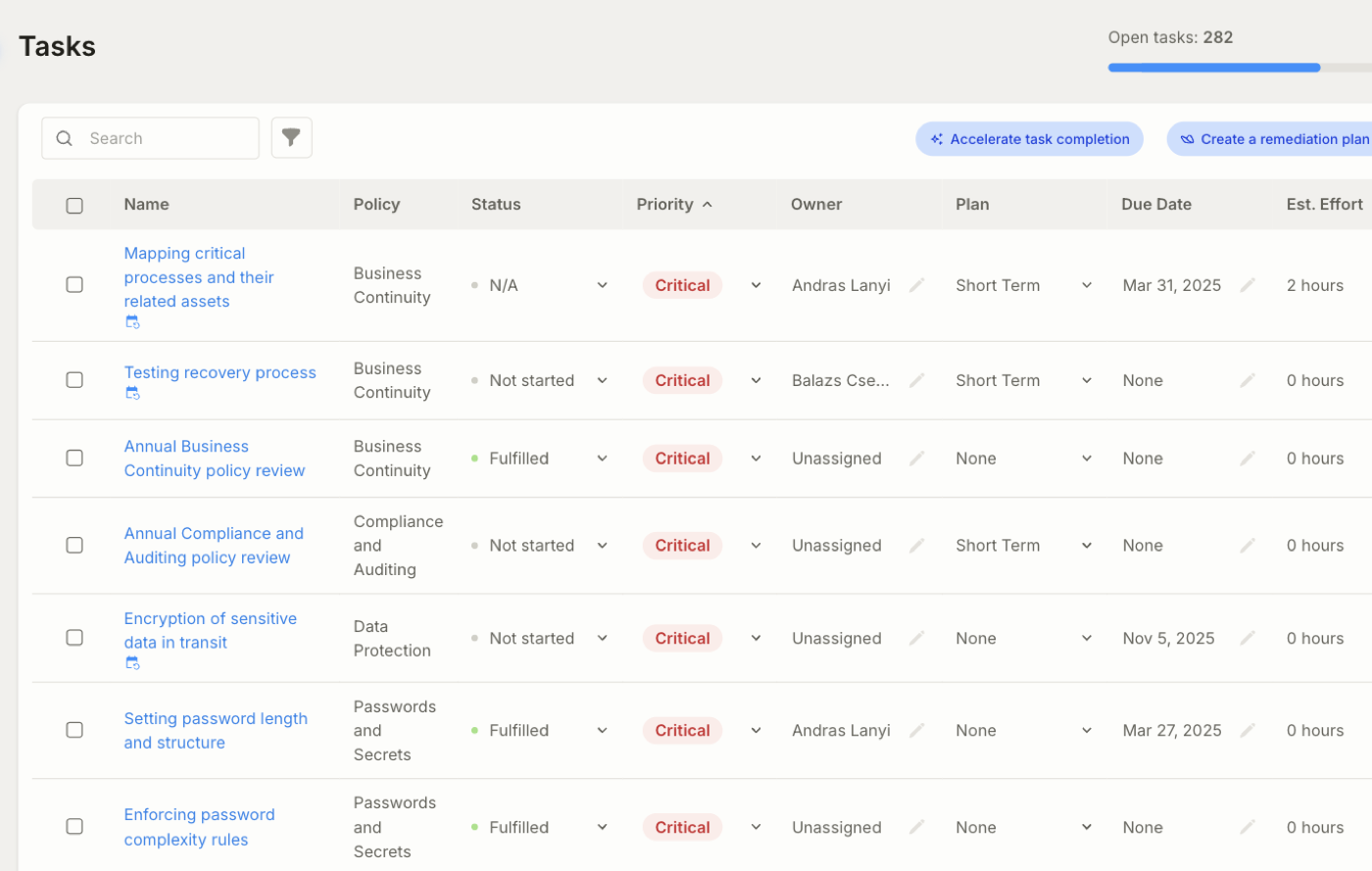
- Remediation tasks prioritized by risk, with an owner and a date on each
- Board-ready reporting, produced from the same source as the work itself
Defining, managing, and optimizing your security programme
Four repeating stages. The first gives you the picture; the rest keep it improving.
- 01
Risk assessments
Through questionnaires and scans of your environment we produce a full assessment and gap analysis of your current risk level and cyber posture, compared against industry benchmarks.
- 02
Cybersecurity plan
We create and execute a plan to bring your organization to the desired level of protection and compliance. It includes tailor-made security policies and actionable, prioritized remediation tasks.
- 03
Ongoing management
We manage the ongoing execution and optimization of the plan — monitoring, scanning, and adjusting where necessary — so you can focus on your core business.
- 04
Cyber posture reporting
You receive in-depth status and progress reports showing your current posture, improvement trends, compliance gaps, and how you compare with industry benchmarks.
Named roles, not advisory hours
A vCISO engagement is not a retainer you draw down against. We take the roles, and the obligations that come with them.
The CISO role
Security strategy, the risk picture, the roadmap and its priorities, and the reporting management and the board actually read.
The senior information security officer role
Where a framework or a contract requires a named senior information security officer — the SISO role — we take it, with the accountability attached, rather than advising whoever holds it internally.
Dealing with the authority
Registration, notifications, correspondence and audit coordination. The regulator has one contact, and it is not somebody in your team learning as they go.
A fixed monthly fee, and no hourly billing
The commercial shape matters as much as the service, because the fear that stalls most decisions is not the price — it is not knowing what the price will become.
- 01
One fixed monthly fee
Agreed before we start, and it does not move because a month turned out harder than expected. No hourly billing, no drawdown against a pot of days, no invoice that depends on how hard a month turned out to be.
- 02
Two rates where there is a deadline
Preparing for an audit is heavier than running the programme afterwards, so the preparation months carry a higher fee and the operational months a lower one. Both are fixed.
- 03
What sets the level
Two things: headcount and the number of sites. Not how many meetings you call, not how the month went, and not how many questions you ask.
- 04
The platform is included
Cynomi is part of the fee on every engagement, not a licence you buy separately and then have to justify.
Working to an audit date?
Organizations that missed the first round of NIS2 audits usually have 180 days, not a year. There is a separate programme for that, and it ends with a decision rather than a hope.
Twenty to two hundred and fifty people?
Enough systems and suppliers to need a security owner, not enough headcount to hire one. What the problem looks like at that size, and which of our services answers which part.
The audit already happened?
Findings with somebody else’s deadline on them, or controls that exist on paper and do not consistently run. Ranked fixes with owners and dates, and the evidence that they operate.
A customer is asking you to prove it?
Questionnaires, audit clauses and evidence requests from the buyers you supply. The answers assembled once, in a form you can send again next quarter.
You run open-source business platforms
A vCISO retainer covers vulnerability handling as a discipline. If you want the raw signal as well — a weekly summary of what was published about the products you actually run, and an alert when one is being exploited — that is free and separate from any engagement.
Security leadership that scales with you
A vCISO engagement is designed to grow into whatever your organization needs next.
Regulatory readiness
NIS2, DORA and ISO 27001 requirements mapped to controls, owners and evidence.
A workforce that helps
Awareness training and phishing simulation turn your people into a control, not a gap.
Third-party oversight
Extend the same governance to the suppliers and partners inside your perimeter.
Frequently asked questions
The questions we hear most often from security and IT leaders.
Something not covered here? Ask us directly
We don’t just provide tools; we provide integrated advisory and technical leadership. By combining our ISO/IEC 27001 certified expertise with an AI-powered Virtual CISO platform, we bridge the gap between complex IT security and business strategy. Our goal is measurable risk reduction: the risks that matter most identified, prioritised, assigned to a named owner and tracked to a date — while your business stays agile and compliant.
A Virtual CISO provides the strategic leadership of a high-level Chief Information Security Officer without the cost of a full-time executive hire. This service is ideal for organizations that need to build a security roadmap, manage risk, and ensure regulatory compliance but prefer a flexible, expert-led model.
We offer an end-to-end compliance journey. This includes an initial gap analysis to identify weaknesses, the implementation of required technical controls (like MFA, encryption, and incident response frameworks), and ongoing monitoring to meet strict EU reporting timelines. We turn compliance from a legal burden into a competitive advantage.
Neither on its own. The engagement is staffed by a team — a lead vCISO, an information security officer, an audit-readiness consultant and a technical expert — so the service does not depend on one person’s calendar, and leave or illness does not stop it. Between them the team holds ISO/IEC 27001 Lead Auditor, NIS2 auditor, ISO/IEC 42001 Lead Auditor, CISA and CISM certifications. The platform runs underneath for the whole term and is included in the fee: it is where your security posture, your compliance status and your open tasks live, not a separate licence you buy.
Above them, not in place of them. We take the security leadership role, and where a framework or the law requires a named information security officer, that role too, including contact with the supervisory authority. Your IT team and your providers keep doing the technical work; we review the controls, specify what has to change, and track it to completion. An outsourced provider is not a blind spot in this model — it becomes a supplier risk we assess, evidenced through their contracts and their own reporting. Statutory accountability stays with your leadership; our work is to prepare those decisions properly.
We do the governance work ourselves, and we do not touch your systems. Writing and updating policies, procedures, system security plans and registers, building the evidence store, running the internal mock audit and the corrective action plan, preparing people for audit interviews, dealing with the authority — that is our work, not a list we hand you. Changing a firewall rule, rolling out MFA or rebuilding a backup schedule stays with your IT team or your provider: we specify it, sequence it, and chase it until it is done. Penetration testing is not part of the fee, though arranging one is.
Platform access is provisioned within about a week of signature, and the kick-off meeting happens in the same week. Inside the first 30 days the named officer is designated and registered where that applies, and the scope is settled and approved by management — which systems are in, and where the boundaries run — with the gap analysis already under way. After that the rhythm is weekly: a short status call on open tasks and blockers, driven off the platform’s task list. Monthly you get a management report on progress against milestones, open risks, and the decisions we need from you. Quarterly we re-review the action plan, the risk register and the supplier assessments; annually, the posture assessment and the training plan. Where a named officer is required on site, that visit happens and is documented every two to three months. Across the year the split runs about 20% on site, 80% remote.
You can start smaller. We run fixed-scope security projects and paid one-off assessments as well as the continuous engagement, and an assessment is a reasonable way to see how we work before committing to anything. We prefer the continuous model because security leadership is not a task that finishes, and the continuous engagement runs on a twelve-month minimum term: a programme dismantled after a quarter leaves you with documents rather than a practice.
A fixed monthly fee, agreed before we start, with no hourly rate and no reconciliation at the end of the month — and the platform inside it. What sets the level is the scope fixed at signature: how many information systems are in, and how they are classified. Where there is an audit deadline the fee is two-stage, higher through the preparation months and lower through the operational months that follow. The fixed fee holds under a fair-use principle: if what you actually need persistently and materially exceeds the scope we agreed, we re-open scope and fee together rather than sending you a larger invoice. Outside the fee: the technical remediation itself and anything it requires you to buy, penetration testing, travel to remote sites, and the audit fee, which you pay the auditor directly.
Ready to get started?
Partner with Spirity Enterprise to implement the right security and IT solutions for your organization.