Protection and risk
Detect online threats before they become business damage
Spirity helps organizations monitor external digital risks across the open web, deep web, dark web, domains, social media, and other online sources — and take action on what we find.
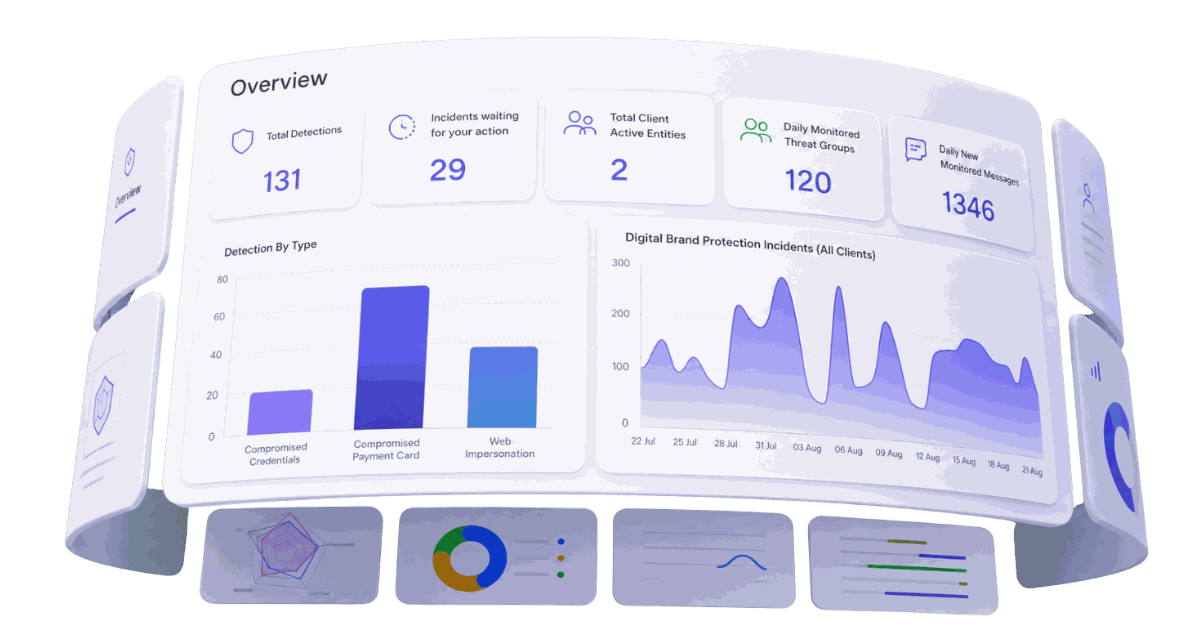
Six modules, one view outside the wire
Digital Risk Protection acts as an early warning system for threats outside your internal environment — where your brand, your executives, and your customers are exposed.
Digital brand protection
Monitors your external attack surface for impersonation of your brand on the web, across social media, and in app stores — more than 200 of them, official and unofficial.
- Files takedown requests with registrars, hosts and platforms once you approve them — case by case, or on a standing order you set
- The abuse complaint goes out within one business day of your approval, with the supporting evidence assembled
Account takeover monitoring
Monitors the clear, deep, and dark web for threat actor activity to prevent emails, usernames, and passwords from being compromised or sold.
- Immediate alerts when credentials are exposed, so accounts can be reset first
Fraud campaign discovery
Monitors private groups in instant messaging applications including WhatsApp, Telegram, ICQ, and Discord to defend against the use of stolen customer data.
- Tracks cybercrime activity that uses stolen customer PII
Data leakage detection
Threat analysts scour clear, deep, and dark web sources, code repositories, social media platforms, and instant messages to provide proactive data leakage detection.
- Covers open source, private groups, and dark web marketplaces continuously
Executive cyber guard
Continuously monitors exposure of personal information, stolen credentials, account hacking and takeover, online impersonation, and identity theft for your executive team.
- Sentiment analysis and validation of VIP mentions across the clear, deep, and dark web
- Protects against financial, reputational, and physical harm
External attack surface analysis
Extensive public and proprietary global internet data provides the capability to assess your network vulnerabilities and weak points from the outside in.
- Maps what an attacker sees before they act on it
Your perimeter stopped being a perimeter
Most of what damages a brand happens where your controls do not reach: a lookalike domain, a cloned login page, a credential dump, an executive impersonated on a messaging app.
By the time those reach your helpdesk, customers have already been harmed. Digital Risk Protection finds them at the earliest stage of the attack and removes them.
- Identify leaked data, phishing pages, fake domains, impersonation, and fraud campaigns before they cause wider damage.
- Protect your company’s reputation by detecting online abuse, fake websites, and attacks using your brand identity.
- Monitor threats that target customers, employees, accounts, credentials, and sensitive information.
- Support quick action against malicious domains, phishing sites, impersonation attempts, and fraudulent online assets.
- Gain a clearer view of risks that exist outside your internal network but can still harm your organization.
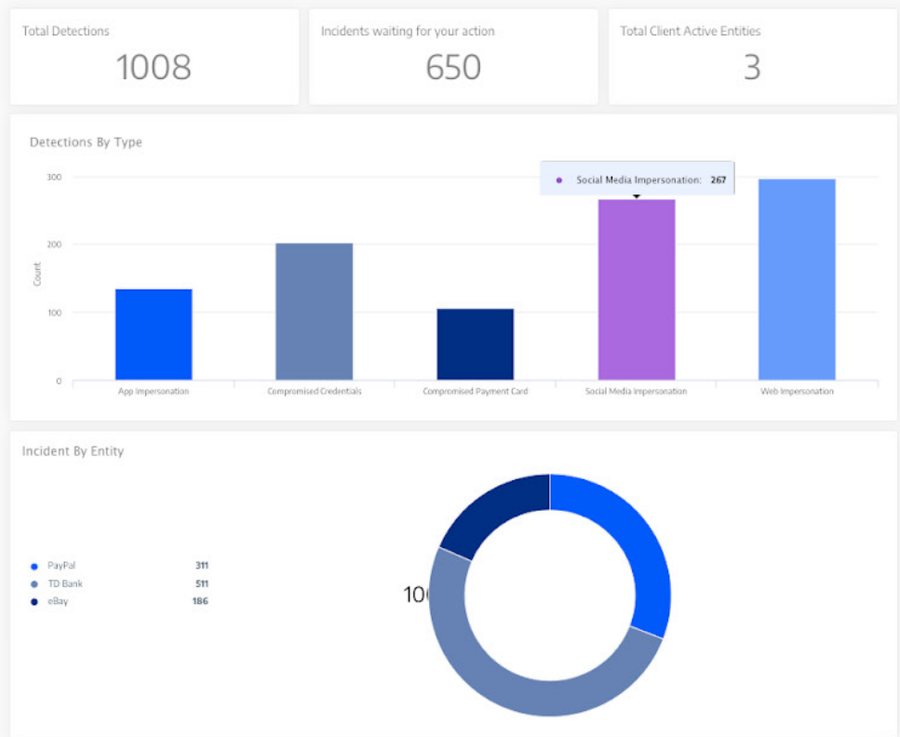
What continuous external monitoring buys you
Proactive impersonation detection
Detect impersonation and take down phishing attacks targeting your organization.
Threat actor engagement
Analysts scour the clear, deep, and dark web to engage with threat actors and proactively identify leaked data.
Executive data monitoring
Monitor corporate executives’ data to prevent financial, reputational, and even physical harm.
Immediate exposure alerts
Receive alerts as soon as data is exposed, in time to mitigate account takeover attempts.
Fraud campaign defense
Defend against fraud campaigns using stolen customer data by tracking cybercrime activity directly.
External threat analysis
Analyze external threats by mapping your attack surface the way an attacker would.
Partner-powered protection with BlueVoyant
Spirity delivers Digital Risk Protection with support from BlueVoyant’s external cyber defense capabilities. That gives you broader visibility into online threats, external attack surfaces, dark web exposure, impersonation, fraud campaigns, and data leakage risks.
Why BlueVoyant?
BlueVoyant provides organizations with comprehensive real-time visibility into external digital threats by continuously monitoring domains and websites, social media, apps in official and clandestine stores, the clear, deep and dark web, and instant messaging. Its global coverage, data science, and analyst expertise enable identification of malicious look-alike attacks, live phishing pages, and more — with the ability to act on your behalf to eliminate threats to your brand, employees, and customers.
Frequently asked questions
The questions we hear most often from security and IT leaders.
Something not covered here? Ask us directly
Yours watch traffic that has already reached you. This watches the infrastructure before it does. A lookalike domain registered and parked for your brand is flagged while it is still dormant — before a single message is sent — along with fake apps, impersonating social profiles and your data turning up where it should not be. The sources are ones an internal team does not hold: passive DNS and registration data at scale, breach datasets, and criminal channels on Telegram, Discord and the dark web.
You approve it — case by case, or through a standing order you set once. Then the round-the-clock Security Operations Centre files an abuse complaint with the registrar, host or platform, with the supporting evidence assembled for you, that request is acknowledged, and the complaint goes out within one business day of the acknowledgement. What nobody can honestly commit to is the removal itself, because that decision belongs to the registrar or the platform, not to us. So the commitment is the filing and the pursuit, and you can see the state of every case in the portal rather than being told it is “in progress”.
No. Takedowns are unlimited inside the annual fixed fee, and the number you request is explicitly not a pricing variable. That is deliberate, and it moves the risk to us rather than to you: a service you hesitate to use because each use costs money is not protection, it is a meter.
Yes, provided that profile was listed at onboarding as one to protect. Facebook, Twitter, Instagram and LinkedIn are covered, both for brand impersonation and for fake accounts using a named executive’s name or photograph. One thing worth knowing before you buy rather than after: phishing domains are searched around the clock, but rogue apps and fake social accounts are searched on business days, and a detected fake profile is reported within 24 hours. The takedown then follows the route above.
A questionnaire, and the service starts when it comes back. It asks for your brand names, logos and trademarks; the domains to monitor and the ones to allow-list; your genuine applications; your official social accounts and the executives to protect; and who at your end should have access. Then a kick-off, portal credentials with multi-factor authentication, and a 14-day tuning period whose stated purpose is output optimised for visibility and accuracy. Detection runs from day one — the fortnight is what keeps it from being noisy.
That is the right question, and it is the difference between this and a threat intelligence feed. Collection is automated, machine analysis strips the obvious noise, and then an analyst enriches what is left — removing false positives, adding context, and attaching a recommended action — before anything reaches you. Your own domains and assets are allow-listed so they never alert, and the tuning fortnight exists precisely for this. BlueVoyant measures the false-positive rate on what reaches the client at under one percent.
Tell you quickly — compromised credentials are searched for around the clock and notified within 30 minutes of detection — then precisely, and with what to do about it: a baseline report of what is already exposed and what is needed to shut those accounts down, then continuous monitoring with immediate alerts as new exposures appear. The resets and the lockouts stay with you, because they are changes inside your systems and your identity provider. What you also get, and what a credential-alerting tool does not include, is the analyst who found it: someone to ask what the source was, how old it is, and whether it is part of something larger.
Only if you ask us to, for a specific case, agreed in advance. It is never automatic, and it is never a standing permission you grant once and forget. The option exists because there are situations where somebody has to talk to these people, and almost no organisation has anyone with the training or the experience to do it safely — it is a specialist skill and the downside of doing it badly is considerable. Where you do ask for it, we can hold that conversation in 24 languages, English, Hungarian and German among them.
Your headcount. Not the number of domains, brands or executives you protect, and explicitly not the number of takedowns, which are unlimited. The reasoning is worth stating because it explains the whole shape of the service: on a fixed annual fee, every takedown we file is our cost rather than yours, so we carry that risk — and the larger an organisation is, the more attackers come for it. Size and incident volume track each other closely enough that headcount is the fairest single variable we have found. Twelve-month term, paid annually.
Ready to protect your digital assets?
To learn more about how Digital Risk Protection combines best-in-class data, advanced analytics, and threat intelligence experts to deliver detection, remediation, and threat prevention, contact us for a demonstration.