Your MSP's patch cadence just became a supply-chain control
Published November 17, 2026·4 min read
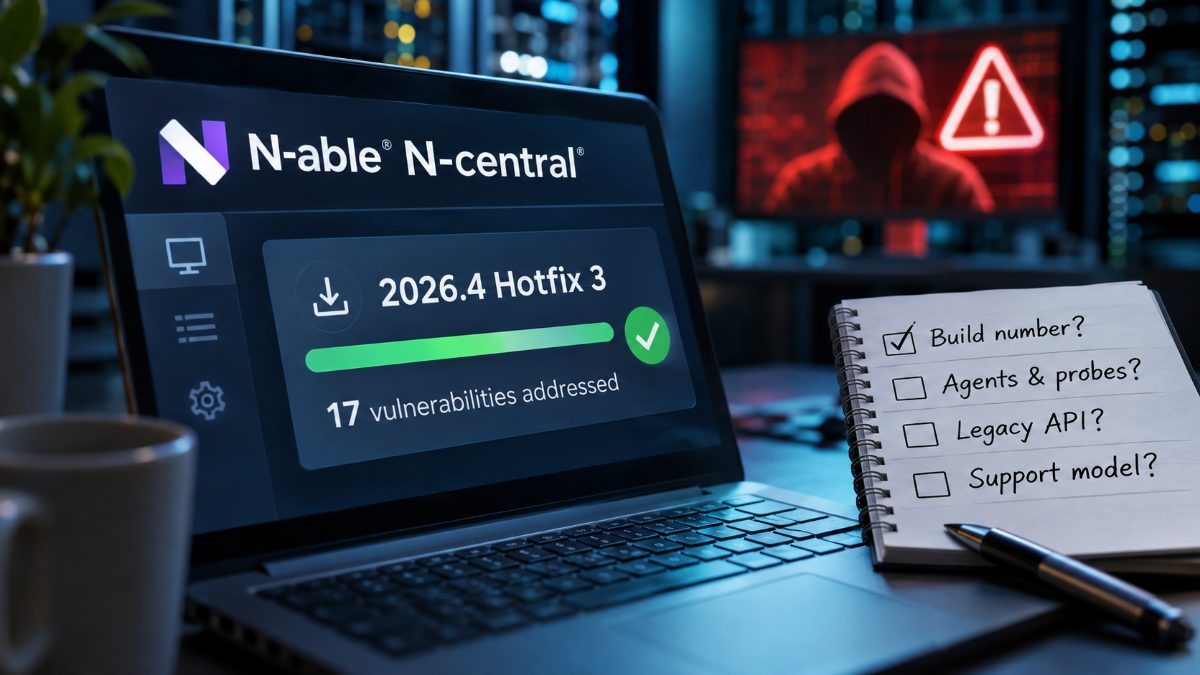
A remote monitoring and management platform your IT provider may be running is now under active exploitation, and the fix that closes the door lives on your supplier's change calendar rather than your own. On 17 November, N-able released N-central 2026.4 Hotfix 3, a critical update addressing 17 flaws, The Hacker News reports; the earlier 4EverAble2Shell and Agent2Shell issues are already being used to deploy crypto miners.
For many readers, this registers as one more RMM vulnerability. That reaction misses the part that should hold attention. If your IT is delivered through a managed service provider, N-central may not appear on your asset list at all, yet it is the class of tooling used to administer endpoints remotely. A single delayed patch on that platform becomes a pivot into your estate.
The patch that will not appear on your asset list
Unless you run N-central yourself, this update will never show up in your vulnerability scanner, your change advisory board, or your monthly patch report. It belongs to whoever administers your endpoints, and that is precisely why it matters. Third-party risk programmes have spent years collecting policies, certificates and penetration test summaries. This update tests a different property: whether the provider patches the tools it uses to touch your systems, and whether it can demonstrate that after the fact.
Most third-party risk registers stop at the supplier's corporate controls. They rarely reach the platforms the supplier operates to deliver the service. N-central is a dependency inside a supplier you selected. The point of an RMM platform is that it is trusted by design to reach every endpoint you have, which is also what makes it dangerous when that trust is misplaced.
N-able's guidance contains a sentence that matters more than the CVE list: "Agents and Probes that are not upgraded are susceptible to impersonation." That moves patching beyond the server. Hosted N-central customers receive the server update automatically, but N-able still requires every customer to upgrade all agents and probes to be fully protected. A supplier using the cloud version therefore still has work to do inside your environment.
Two questions that separate patch claims from patch evidence
What a supplier says in a meeting is not evidence. Two questions get closer to the operational truth. First, is the N-central instance hosting your estate run on-premises or hosted by N-able? If it is on-premises, the hotfix is manual and the supplier should be able to produce the build number without a long pause. If it is hosted, the server side is being updated automatically, but the agent and probe question remains.
Second, how many agents and probes in your estate are still on the previous version? Ask for a deployment figure and a completion date. A pledge that patching is handled is not an answer.
The uncomfortable follow-up concerns the legacy API. Successful exploitation of 4EverAble2Shell depends on the legacy API mode being enabled. Hotfix 3 removes that configuration option entirely, which closes the route, but it also means a supplier that had left legacy APIs switched on for integration convenience was exposed in a way no annual questionnaire would have surfaced.
Remote control and Intune integration are currently blocked in the release. If your MSP's support model depends on either, asking how they are delivering support this week tells you more about their operational maturity than the last certificate they filed.
The supplier conversation after the patch
None of this will be settled by the next annual security questionnaire. The useful distinction is not whether the supplier has a patch management policy, but whether it can produce the current build number of a tool under active exploitation, on demand, for your account. That is a different standard of evidence.
The sequence from disclosed flaw to crypto miners moved quickly enough that a spreadsheet of vendor contacts cannot keep up. This is the case for third-party risk run as a managed programme: checking what suppliers claim against live monitoring and driving remediation with the third party rather than waiting for the next renewal. Supply chain defence and third-party risk work is built around that rhythm.
Ask your MSP for the build number of the N-central instance that manages your estate, whether it is hosted or on-premises, and how many agents and probes remain on the previous version. Then ask who owns that answer. If the response is a policy reference or a promise to check, you have learned something more durable than the CVE score. The patch window will close, but the gap in how your supplier proves operational control will remain.
- managed service providers
- third-party risk
- supply chain security
- patch management
- remote management