The synthesised CEO call is already the cheapest way past your approvals
Published September 24, 2026·4 min read
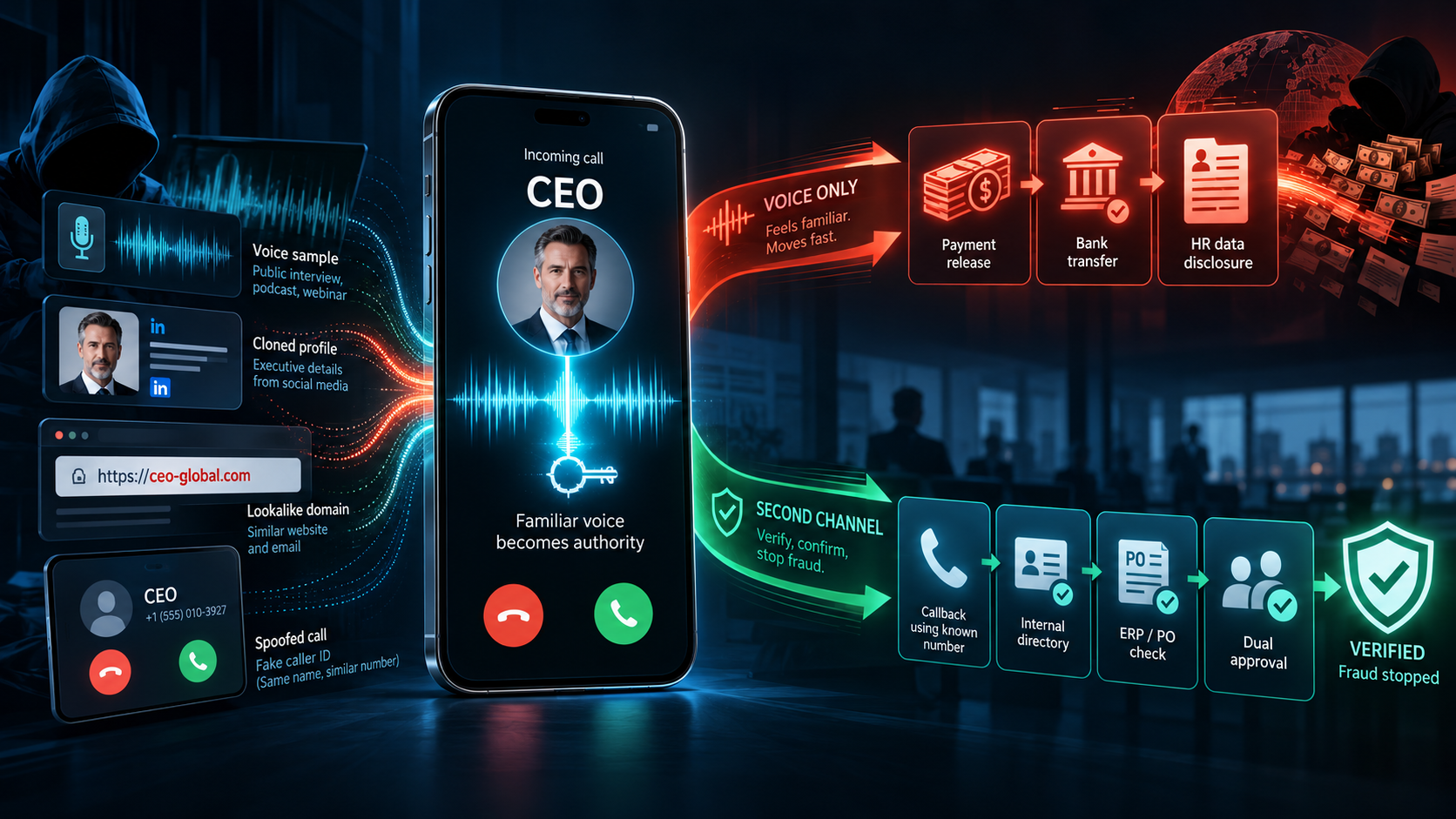
Consider the call that lands on a finance director's desk on a Thursday afternoon. The caller ID says the chief executive; the voice sounds like her; the instruction is plausible: settle the outstanding invoice before the auditors arrive, and don't let procurement slow things down. The person who answers has approved similar payments before. The call is over in four minutes.
Help Net Security reported on 22 September that attackers are already using AI to create digital copies of assets ranging from logos to "people’s voices", and that clients are reporting "executive impersonation on LinkedIn". The underlying report, CSC’s State of Online IP Risk 2026, surveys 300 senior executives specialising in intellectual property law. It frames the threat as an infringement problem: counterfeit goods, domain abuse, fake marketplaces. The more useful reading for a security or IT leader is narrower and closer to home.
A copied voice is not primarily an intellectual property dispute. It is an authorisation token that enters the company long before anyone files a takedown. In a 500-person business, the person who can release a payment is usually the same person who takes the call. If the voice is familiar and the number looks right, the payment goes out. That is a process vulnerability, and it can be exploited without touching a single internal system.
Where the voice becomes authority
Most staff assume a call from the chief executive is proof of instruction. In a mid-market firm, that assumption is not challenged because it usually works. One finance clerk can change a supplier’s bank account because the voice on the line asked them to. One HR administrator can send payslips or contracts to a new address after a plausible call. There is no security review between the request and the action. The familiarity that keeps a company moving is the same familiarity the impersonator spends seconds replicating.
The CSC report notes that attackers use AI to copy people’s voices and that fake chief executives contact people through professional networks to collect personal information. Put those two facts together and the attack path writes itself. A short recording from a conference or a podcast provides the voice. A fake LinkedIn exchange provides the names, roles and personal context. A payment instruction sent to the one person who can approve it does the damage. Nine in ten respondents to the survey said AI-enabled systems were increasing the frequency of these threats. The same generation tooling that scales counterfeit listings also scales the familiar call.
The part outside your estate
When the call reaches finance, it is already too late for endpoint detection. The caller ID is spoofed; there is likely no malware, no anomalous login, no network beacon. The attack runs where the organisation does not look: a cloned social profile, a lookalike domain, a recording of the executive speaking at a conference. Digital risk protection is the layer that finds those outside assets and gets impersonations removed before staff are tested with them. The aim is to remove the raw material the call depends on. With registrar partnerships, a found lookalike can often be taken down in a day or two, before it becomes a call.
What the survey does not establish is how many of those calls have already cleared a payment or released personal data. Reporting is still thin on that, but the pieces are all present.
The control that stops the payment
Waiting for synthetic audio detection is too slow. The process itself has to become the control. For a finance or HR team of a few people, the workable rule is simple: no instruction that arrives only by voice or social message may move funds or personal data unless it is confirmed through a second channel the caller cannot influence. That could be a callback to a number already stored in the internal directory, a purchase order in the ERP that the caller cannot edit, or a second approver who was not named in the call. The important part is that the confirmation channel is chosen by the receiver, not offered by the caller.
This friction is the point. It will slow down one legitimate urgent payment a quarter. That is a trivial cost against the alternative: a single point of failure sitting in the most trusted voice in the company. The finance director should not be able to override the second channel because the caller sounded upset.
Checks that change the attack
Three things to run in the next two weeks:
- Ask finance, unprompted, what they would do if the CEO called from an unknown mobile number asking them to change a supplier’s bank account. Record the answer.
- Ask HR which personal data request they would fulfil on the strength of a phone call alone, and write down the first one they name.
- Pick one executive whose voice is easy to source online, and search for cloned social profiles and lookalike domains in their name. If you find one, you have a board-ready demonstration.
The campaign will keep working until the first minute of the call stops being easy. For most organisations, the first minute is easy because the voice is familiar and the process trusts it. Remove that trust, and the attacker has to find another way in.
- synthetic voice fraud
- executive impersonation
- digital risk protection
- payment fraud
- social engineering
- ai voice cloning