A six-hour reporting window only works if you name the notification owner beforehand
Published November 21, 2026·3 min read
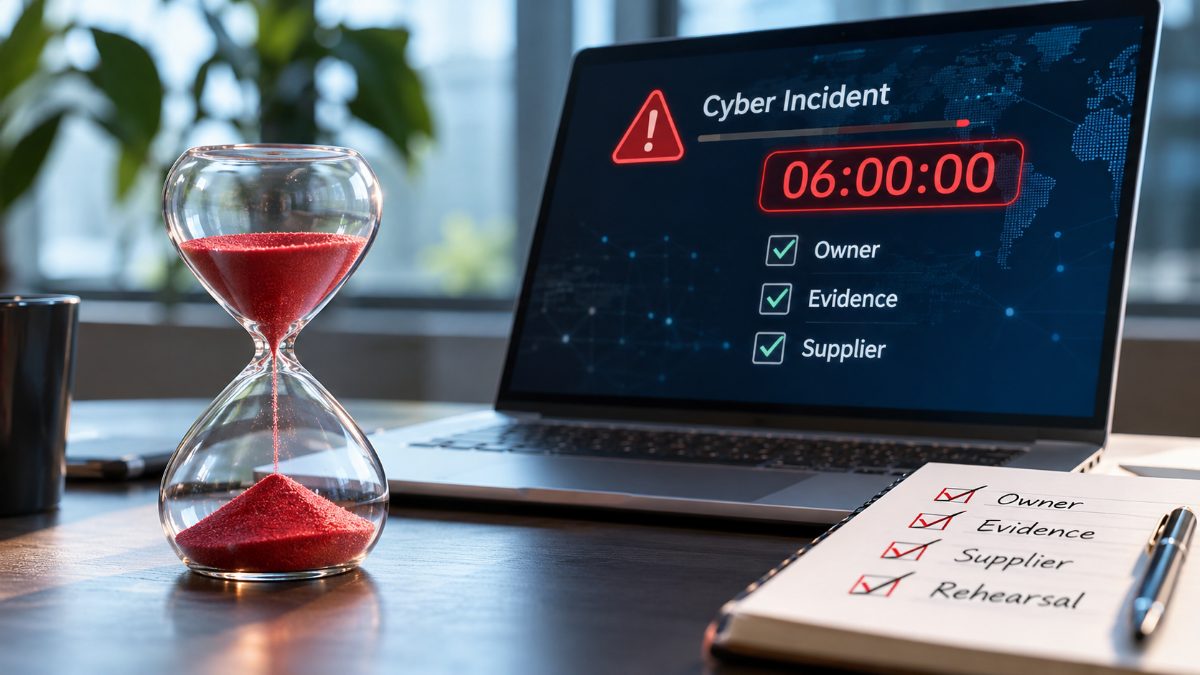
Six hours sounds short because it is measured from detection, and most organisations do not know who owns detection as anything other than a technical fact. The Reserve Bank of India's revised Master Directions on Cyber Resilience and Digital Payment Security Controls, reported by The Times of India on 15 November, require non-bank payment system operators to notify the central bank of cyberattacks, critical system outages and settlement delays within that window.
The temptation is to file it under India-specific payments compliance. The more useful reading is that a reporting deadline this short exposes the notification machinery a regulated firm is supposed to have built before an incident. The same pressure now runs through NIS2, DORA or sectoral rules, which shorten the time between detection and first regulator contact for many readers; which duties apply and at what threshold depends on sector and jurisdiction. The design pressure is the same. Six hours does no work unless three things are already in place: a named owner, a defined evidence chain, and a supplier leg that has been rehearsed.
The clock starts at detection, so detection needs an owner
In many organisations, detection is what the monitoring tool does. That is the wrong place to start. A six-hour window does not begin when an analyst triages an alert; it begins when someone with authority decides the event meets the reporting threshold. If that decision requires three escalation hops, the notification is already late before anyone starts writing. The first governance task is to name a person with the authority to declare an incident reportable at any hour.
For readers without a 24-hour rota, that often means one named executive and one named deputy, and the deputy may be the same person who was reviewing firewall changes on Friday afternoon. Where there is no full-time security leadership, a virtual CISO can occupy the owner role, but the name still has to appear in the incident response plan. That is exactly why the naming has to happen now.
Notification is an evidence chain
Six hours is enough to write a report. It is not enough to reconstruct one. At the moment of detection, the organisation is assembling the same pieces: the first log line, the affected account, the containment action, the supplier who has not yet responded. The regulator's interest in what happened is smaller than its interest in what you knew, when you knew it, and what you did inside the window.
That means the evidence chain has to be built before the incident: where detection logs live, who controls them, how long they are retained, and how they are exported while the primary system is still in containment. It also means keeping the notification format close. The Indian rules prescribe a format for payment system operators; many regimes do the same, and producing a first report under time pressure is much easier when the fields map onto evidence you already collect.
Rehearse the supplier leg
The source article also draws attention to third-party software. One executive quoted there argues that many incidents begin in vendor code the operator cannot see, and the rules require source code for critical third-party applications to be held or kept in escrow. That detail matters more than the six hours themselves. In a mid-sized organisation, the notification workflow has one leg inside the estate and one leg that runs through a managed security provider, a payment processor, a hosting company or a software vendor. The six-hour window will be consumed by the slowest leg, and most firms do not discover which leg that is until they are inside an incident. A realistic rehearsal should deliberately choose an incident that starts in a supplier's system.
Most of our advisory work starts with this ownership and evidence question, because it is the cheapest control to fix and the first one a breach exposes.
Run the rehearsal on a timed clock. Pick a synthetic payment-platform incident, start from the detection timestamp, and record where the chain stalls. If the call comes on a Sunday and the named owner is on a flight, who has the authority to file?
- incident reporting
- governance
- breach notification
- regulatory compliance
- third-party risk