AI has compressed the CISO's job from periodic checks to continuous exposure management
Published November 21, 2026·4 min read
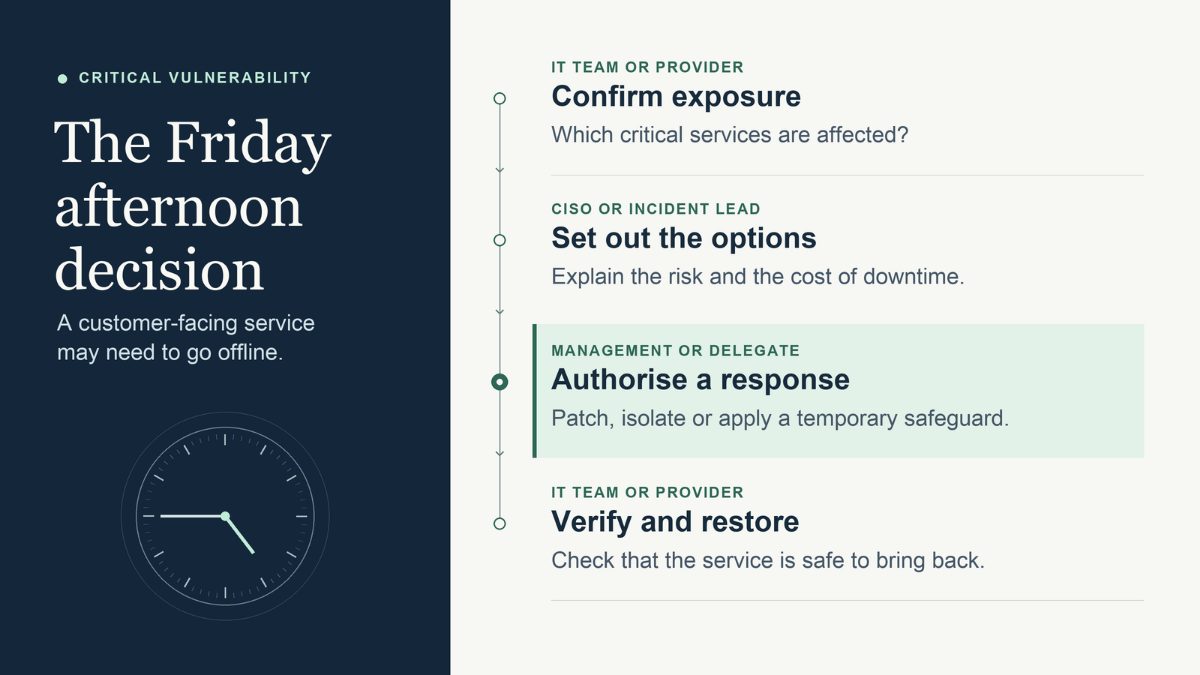
A critical vulnerability is disclosed late on Friday. Your IT provider can isolate the affected system, but doing so would interrupt customer orders. Who can make that call, and what information will they need? For a mid-sized Austrian company without a full-time CISO, that decision is a useful test of how well cybersecurity is managed.
Austria’s NISG 2026 took effect on 1 October 2026. It requires the management bodies of essential and important entities to oversee cybersecurity risk measures and attend training tailored to their responsibilities. On 19 November, the Bank of England, the Prudential Regulation Authority and the Financial Conduct Authority published practices for UK financial firms facing faster AI-assisted attacks. For Austrian companies, the two developments raise a practical question: can management make a reasoned decision while there is still time to act? Austrian legislation · UK regulators’ joint publication
Find the exposures that can disrupt your business
AI is speeding up vulnerability discovery. When a new alert arrives, the first questions are whether you run the affected software, whether the system is exposed and what would happen if it went offline. An internet-facing service that takes customer orders may need an emergency fix ahead of a higher-scoring flaw on an isolated test system.
Start with your existing asset, risk and supplier registers. Check that they cover internet-facing systems, privileged accounts, AI assistants and their connections to company data, and the suppliers that keep critical services running. Give each significant finding an owner and a due date. Agree in advance who can authorise an emergency change, and record any temporary safeguards while a fix is pending. A CyberFundamentals (CyFun) assessment can help you identify gaps, prioritise fixes and decide what evidence to keep.
Review what AI tools can see and do
An AI assistant connected to company files can surface sensitive information that an employee already has permission to open. A folder shared years ago with the whole company may suddenly be easy to search and summarise. Review access to sensitive repositories before rollout, remove obsolete permissions and check what connected tools can read or change.
Give staff an approved AI tool and clear rules for handling customer data, financial records and source code. A short policy with examples gives people something they can use when a deadline is tight. Define who validates AI-generated security findings and who can pause automation if it recommends a change that could disrupt operations. If AI is already embedded in several teams or products, an ISO/IEC 42001 readiness assessment can help you formalise who approves AI use and how risks are reviewed over time.
Ask critical suppliers how they handle AI and patching
Supply-chain security is part of NISG 2026’s risk-management requirements. Suppliers can expect questions and contractual requirements from customers in scope. Start with providers you would struggle to replace during an incident. Ask where AI is embedded in their service, what data it can access and how quickly they notify you of a critical vulnerability and apply a fix. Where a service depends on a key subcontractor or open-source component, ask how the provider tracks that dependency. Put notification and remediation commitments in the contract so your team knows what to expect when an alert comes in. See Spirity’s Supply Chain Defense service for ongoing supplier assessment and monitoring.
Give someone responsibility for following through
For a company without an internal security lead, Spirity’s virtual CISO service provides a dedicated adviser who maintains the risk register, turns findings into a remediation plan with named owners and due dates, and tracks evidence as work is completed. Your IT team or provider implements the technical changes. Weekly follow-ups address stalled work, and monthly reporting gives management a view of open risks, progress and decisions that need its attention. Under NISG 2026, the management body retains its oversight responsibilities.
If your organisation was an essential or important entity when the law took effect, the initial registration deadline is 31 December 2026. Start by checking your classification in our NISG 2026 guide and follow the filing instructions from the Federal Cybersecurity Office.
At your next management meeting, pick one critical service and rehearse that Friday-afternoon decision. Ask who gets the alert, who can approve a workaround and how you will confirm the service is safe to bring back. Any unanswered question belongs on the action plan with an owner and a date.
- ai-security
- nis2
- exposure-management
- supply-chain-risk
- vciso
- cyber-governance